Register

High-performance cloud volumes for reliable data storage


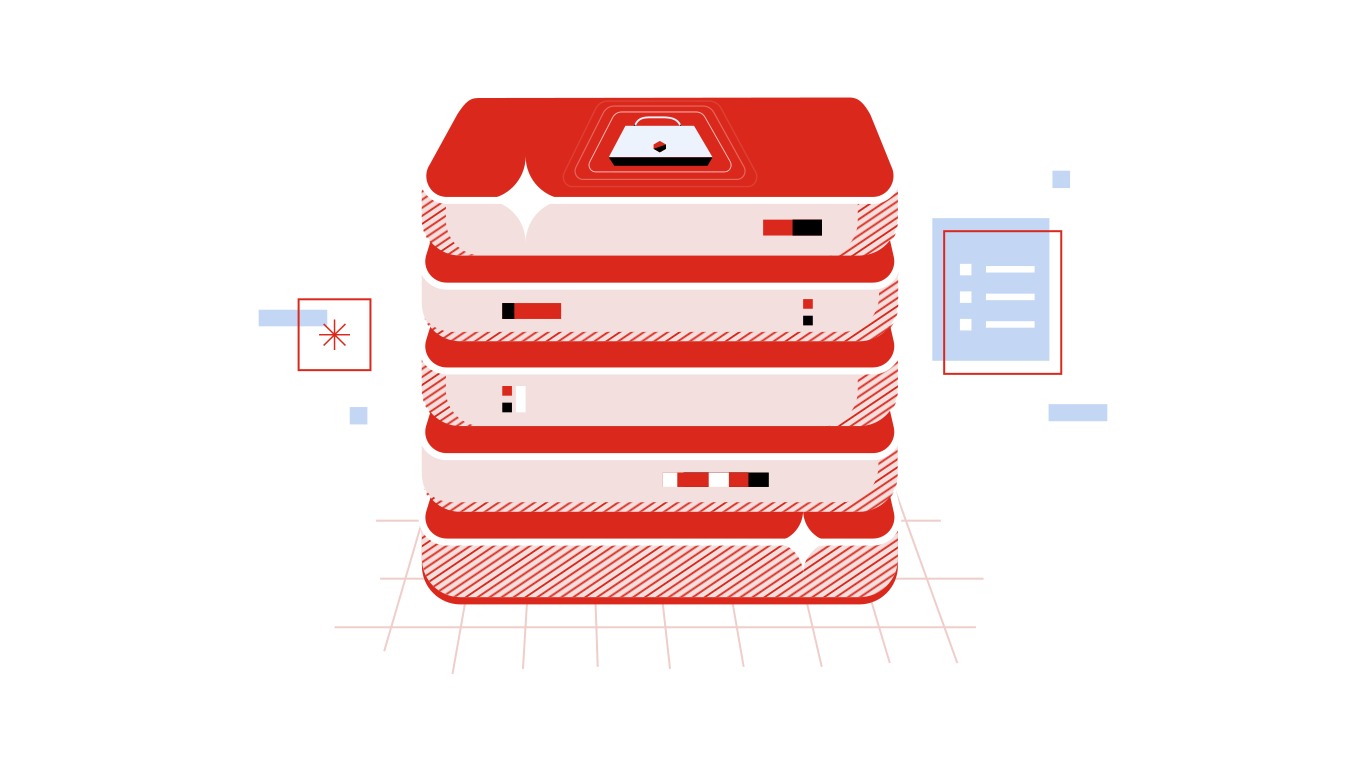
Exoscale Block Storage solution provides persistent volumes that integrate seamlessly with your Compute Instances, enabling you to store and manage critical data. The service is designed for workloads that require consistent performance, low latency, and strong durability, including databases, analytics platforms, and Kubernetes workloads.

Data is replicated within the same zone for durability, and volumes can be resized or reattached as your requirements evolve without disrupting ongoing operations. Block Storage offers a secure and scalable foundation for modern data management.

Why choose Exoscale Block Storage

High data durability

High Data Durability

Multiple copies of data stored at all times on distinct servers. Unlimited snapshots retention.

Built for low-latency workloads

Built for low-latency workloads

Benefit from high performance for your latency-sensitive applications, such as databases. All backed by the latest generation NVMe SSDs.

flexible storage capabilities

Flexible Storage Capabilities

Keep your data independent from instance local storage. Resize volumes as needs grow, or detach and reattach them to another instance within the same zone.

Data storage has never been faster

Exoscale

Run modern workloads with Exoscale Block Storage

The Choice for I/O Intensive Applications


Based on its unique characteristics, the Block Storage solution is the choice for mission-critical and I/O intensive applications. It is commonly used for relational and transactional databases, time series databases, virtual machine disks, and Kubernetes workloads. Because Volumes are directly connected to an instance, their I/O speeds are much faster than those of an alternative storage solution like Object Storage.

Application data management


Compute Instances and containerized environments benefit from the flexibility of Block Storage, which keeps volumes available across reboots and allows them to be attached to different instances. As projects evolve, applications can seamlessly access the same data without interruption, supporting long-term efficiency.

Flexibility for Containerized Applications


Being equally flexible, scalable, and efficient, block storage is the perfect match to containerized applications on the cloud. Containers benefit from the speed of block storage and the native ability for a single host to mount multiple block storage volumes. Seamlessly migrate between servers, locations, and operating systems.

Persistent Volumes


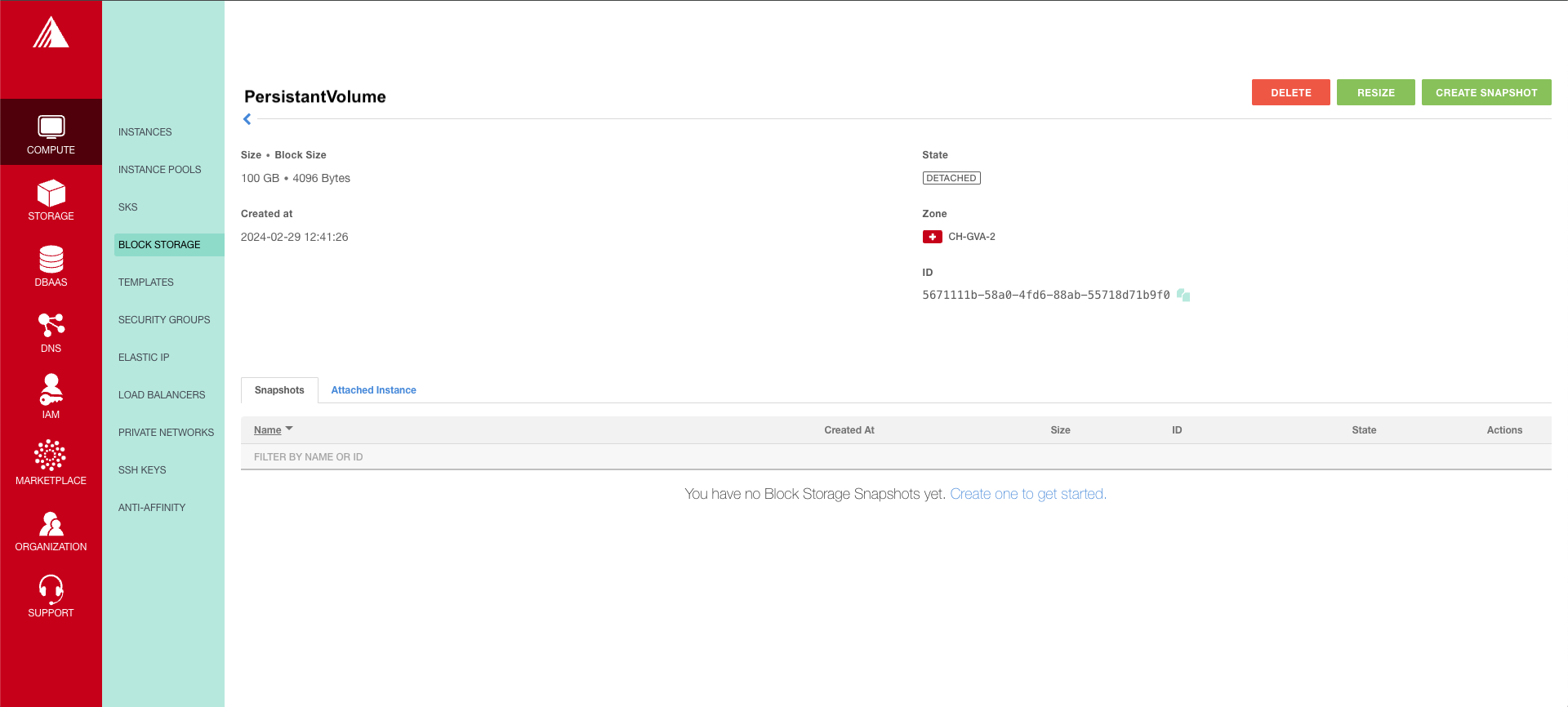
Retain data over longer periods. Create persistent volumes for storing critical data, databases, or other important information that need to be stored and accessed across multiple instances or sessions.

Block Storage Features

Combine Block Storage with...

…other Exoscale products. Easily compatible with SKS, Object Storage or Compute.

Compute Instances

Compute Instances

Flexible virtual machines optimized for general-purpose, memory-intensive, CPU-bound applications or GPU workloads. Combine with your Kubernetes workloads to scale efficiently across all use cases.

Discover
Hosted & Managed Kubernetes

Scalable Kubernetes Service

Deploy containerized applications on a production-ready hosted and managed Kubernetes cluster in under two minutes. Use SKS as the orchestration layer for your application pods, using SKS worker nodes as the underlying compute layer.

Discover
object-storage

Simple Object Storage

Use a highly scalable and S3-compatible storage solution for unstructured data. Ideal for storing backups, logs, static assets, or media, fully integrated with Exoscale regions and access-controlled via API.

Discover

Predictable pricing for performance-sensitive workloads


Exoscale Block Storage is billed per provisioned GiB.hour, with the same model applied to volume snapshots. Pricing is simple and predictable, with no separate IOPS provisioning.

Product Details Price ({{ currency | uppercase }})
Volume per GiB.hour {{ prices['blockstorage']['volume'][currency] | number:8 }}
Volume Snapshot per GiB.hour {{ prices['blockstorage']['snapshot'][currency] | number:8 }}
  1. [1]

    Available in all Zones

  2. [2]

    Compatible with instances that are at least of Small size.

  3. [3]

    Block Storage volumes require a minimum size of 1 GiB and have a maximum size of 10 TiB per volume.

Block Storage trusted by engineers across Europe

Exoscale Cloud Block Storage provides volumes that adapt to dynamic workloads and ensure consistent availability across European zones. Our experts support organizations in building infrastructures that are optimized for performance and aligned with strict compliance standards. Contact us today to discuss how Exoscale’s Cloud solution platform can support your long-term infrastructure strategy.

Contact us

Explore More Exoscale Services

Extend your infrastructure with complementary offerings that help you achieve higher availability, better performance, and expert support for any workload. Exoscale has the right service to support your project’s growth.

Database as a Service (DBaaS)

Database as a Service (DBaaS)

Simplify data management with managed databases, including PostgreSQL, MySQL, Kafka, OpenSearch, Valkey, and Grafana, designed to seamlessly integrate with your applications.

Discover
GPU Cloud Computing

GPU Cloud Computing

Built for compute heavy workloads like machine learning, data processing, and scientific simulations. Easily integrate GPU nodes into your Kubernetes clusters for accelerated performance where it matters most.

Discover
Support Plans

Support Plans

Get the help you need to run your infrastructure with confidence through flexible support plans, designed to provide expert guidance, faster response times, and dedicated assistance tailored to your business.

Discover

Get started with our Block Storage tutorials

Structured tutorials provide a clear introduction to the practical use of Block Storage service. They cover deployment, integration with Compute and Kubernetes, and recommended methods for secure and efficient data handling. With precise guidance, teams can implement reliable storage processes that align with technical and business requirements.

Quick start with Block Storage

Follow a step-by-step guide to create your first volume within minutes. Learn how to attach, detach, and manage storage reliably across different instances.

How-To guides for Block Storage

Explore practical how-to tutorials that cover snapshot management, replication, and scaling. These resources provide clear instructions to ensure consistent data handling and stable application performance.

Frequently asked questions about Block Storage

What is Block Storage?

Block Storage is a cloud service that provides fixed-size volumes acting as virtual disks within an operating system. It ensures persistence, durability, and consistent performance for databases and other I/O-intensive applications.

What can Block Storage be used for in the cloud?

Block Storage service is used for relational and transactional databases, analytics workloads, and containerized environments that demand stable throughput. It also supports backup, disaster recovery, and application data management in long-term scenarios.

What is the difference between Block Storage and Object Storage?

Object Storage is an unstructured service accessed via an HTTP REST API, billed according to the actual size of stored data. Block Storage provides predefined volumes mounted at the operating system level, making it suitable for applications and databases that require low latency and direct disk access.

Why should I use Block Storage instead of Local Storage?

Local storage on a Compute Instance is permanently tied to the machine and cannot be reassigned. Block Storage allows volumes to persist independently, scale up to 10 TiB, and be reattached across different instances.

How are Block Storage Volumes charged?

Block Storage volumes are charged per GiB.hour for the full provisioned capacity of the Volume. They are accounted whether the volume is attached or not to an instance and the resolution goes down to the second.

Can Block Storage Volumes be resized?

Block Storage Volumes can be resized throughout their lifetime to an upper value in one operation. The scale volume function is available via the API, CLI or Portal. The file system hosted on the volume requires an expansion after volume size increase.